One of Prague’s buildings that really fascinated us was The Dancing House. I know what you’re thinking: all of those fabulous historic sites and we’re obsessed with a weird building that was completed in 1996. But the more we learned about it, the more interesting it became.
We first noticed a nighttime Dancing House overlooking the river when we took our river cruise.
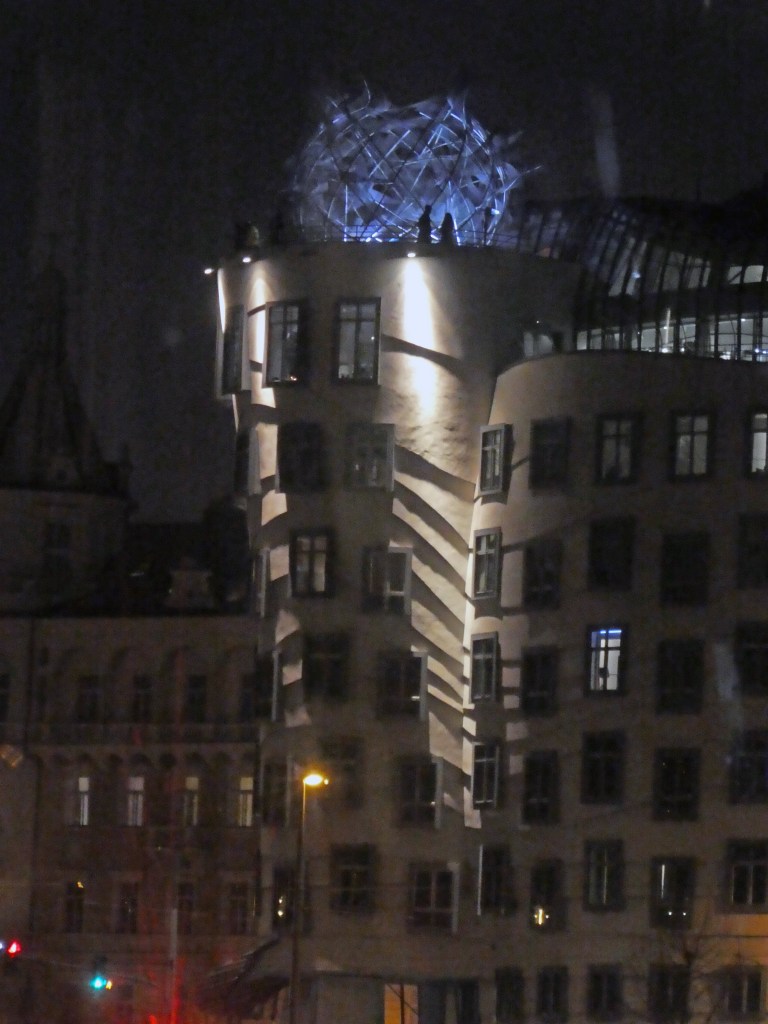
Then we just happened to drive by the House twice more while we were in Prague. We knew we needed to find out the story behind this strange structure.
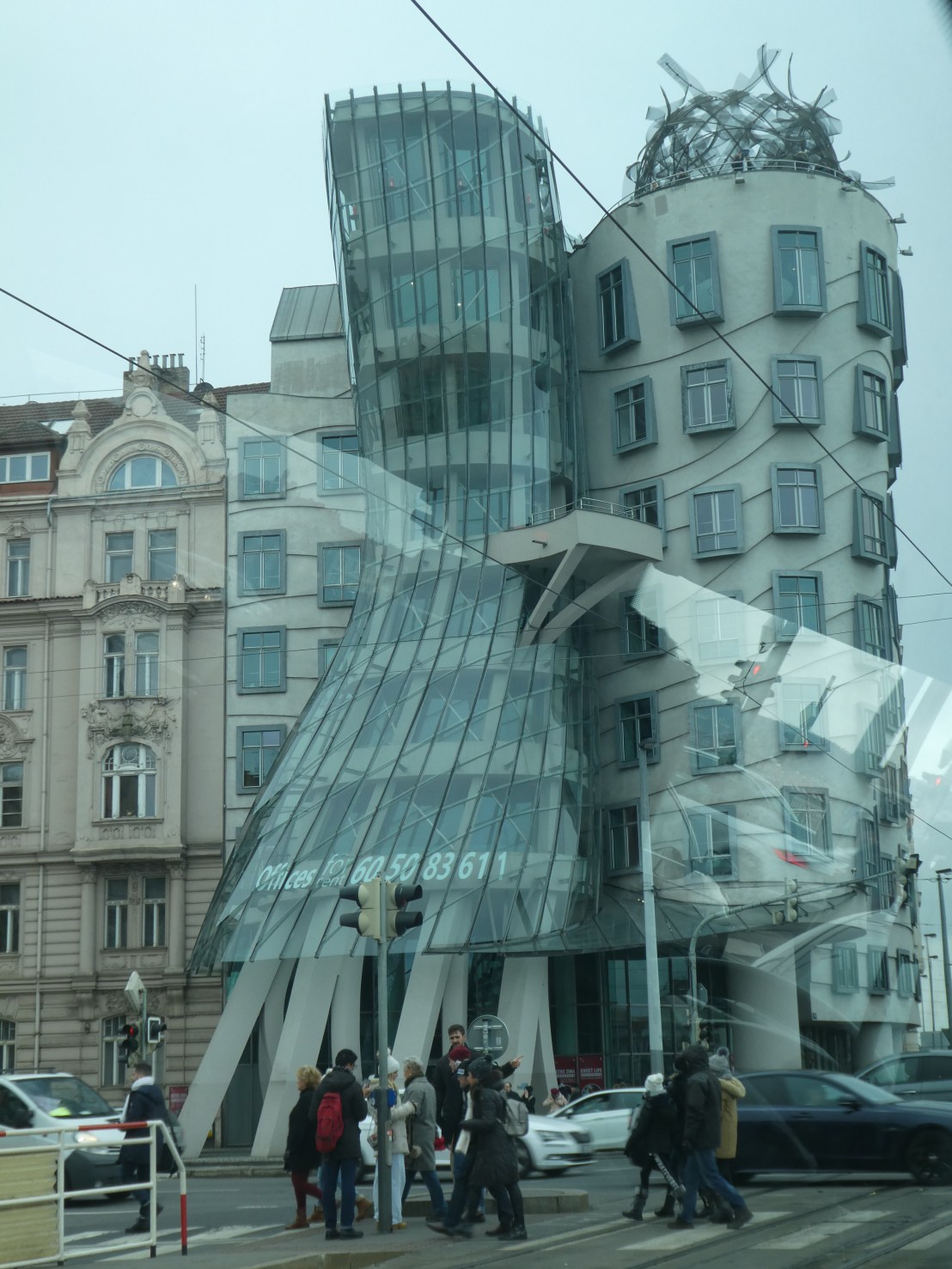
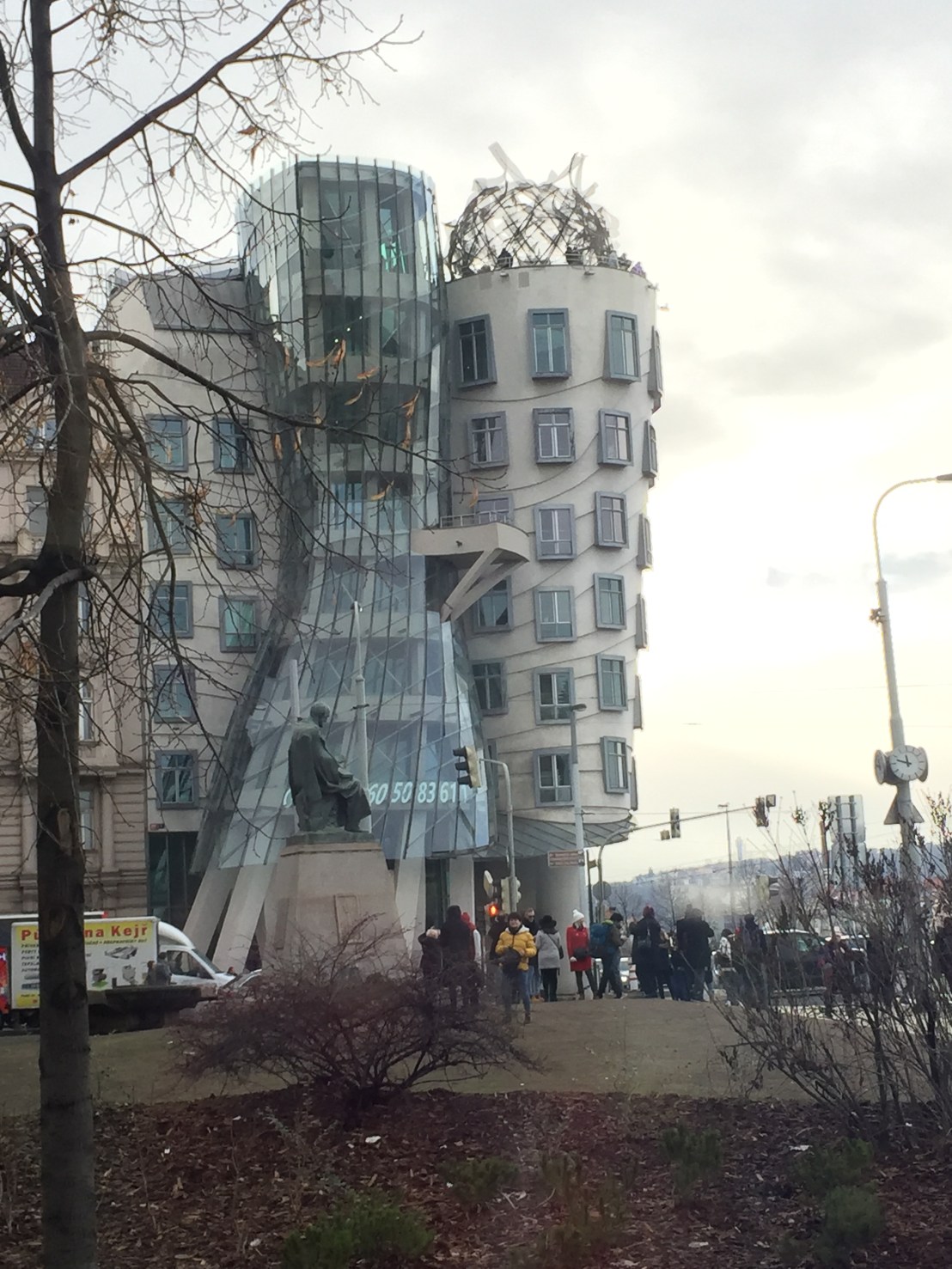

The Dancing House is officially the Nationale-Nederlanden building, named for the Dutch Insurance company that sponsored the building. The building was designed by a Croatian-Czech architect in cooperation with Canadian-American architect Frank Gehry (think Walt Disney Concert Hall among others). The style is deconstructivist (also called neo-baroque), making it stand out from the baroque, gothic and art nouveau buildings for which Prague is famous. The original idea was for a building consisting of two parts, static and dynamic (“yin and yang”), which were to symbolize the transition of Czechoslovakia from a communist regime to a parliamentary democracy.
Gehry originally named the building Fred and Ginger because the house resembles a pair of dancers. The glass tower “Ginger” bends and clings to the concrete tower “Fred.” The “dancing” shape is supported by 99 concrete panels, each a different shape and dimension. On the top of the building is a large twisted structure of metal. The building’s design was driven mainly by aesthetic considerations. Although it is the same height as the two adjacent 19th century buildings, aligned windows would make it evident that the building actually has two more floors than its neighbors. The windows also have protruding frames, such as those of paintings, so that they would have a three-dimensional effect. The winding mouldings on the facade also serve to confuse perspective and diminish contrast with the surrounding buildings.
The building is 9 floors tall plus two floors underground. The layout of each of the floors varies due to the asymmetrical shape of the building, causing the rooms inside to also be asymmetrical. The commercial areas of the building are in the lobby and the first floor. The six floors above that were primarily office spaces. The ninth floor housed a restaurant. Since the building takes a slim shape, and the building is split into two parts vertically, the office space is limited. To make the most of the space, the architect used design elements common in ships and incorporated small hallways into the interior of the building. The total interior of the building is 40,000 square feet.
In 2016, 2 floors of the building were renovated into a 21-room hotel. The hotel also has apartments available in each of the towers named after Fred and Ginger. The Ginger & Fred French Restaurant now operates on the 7th floor and there is now a glass bar on the 8th floor. There is also now an art gallery in the building.
The Dancing House was awarded Time Magazine’s Design of the Year award for 1996.
 Christmas Markets & More
The dancing house has to be the weirdest structure I’ve ever seen. I can only imagine the nightmares the construction company had making the architects vision come to life. Very interesting.
LikeLike